Email design system
Build an Email Design System Around Your HTML
Reusable modules, color and type tokens, and guardrails. The system is your HTML, not a proprietary framework wrapped around it.
Start building freeStart from the HTML you already trust
An email design system that replaces your HTML gives you modules you do not own. The export is a dialect. The next tool cannot read it. EmailStitch starts from standard HTML you can already send, then wraps tokens and modules around that file.
You can still open the HTML editor and change the structure. The canvas is how the rest of the team assembles a campaign from pieces that already survived production. It is not a second source of truth.
Modules marketers can assemble
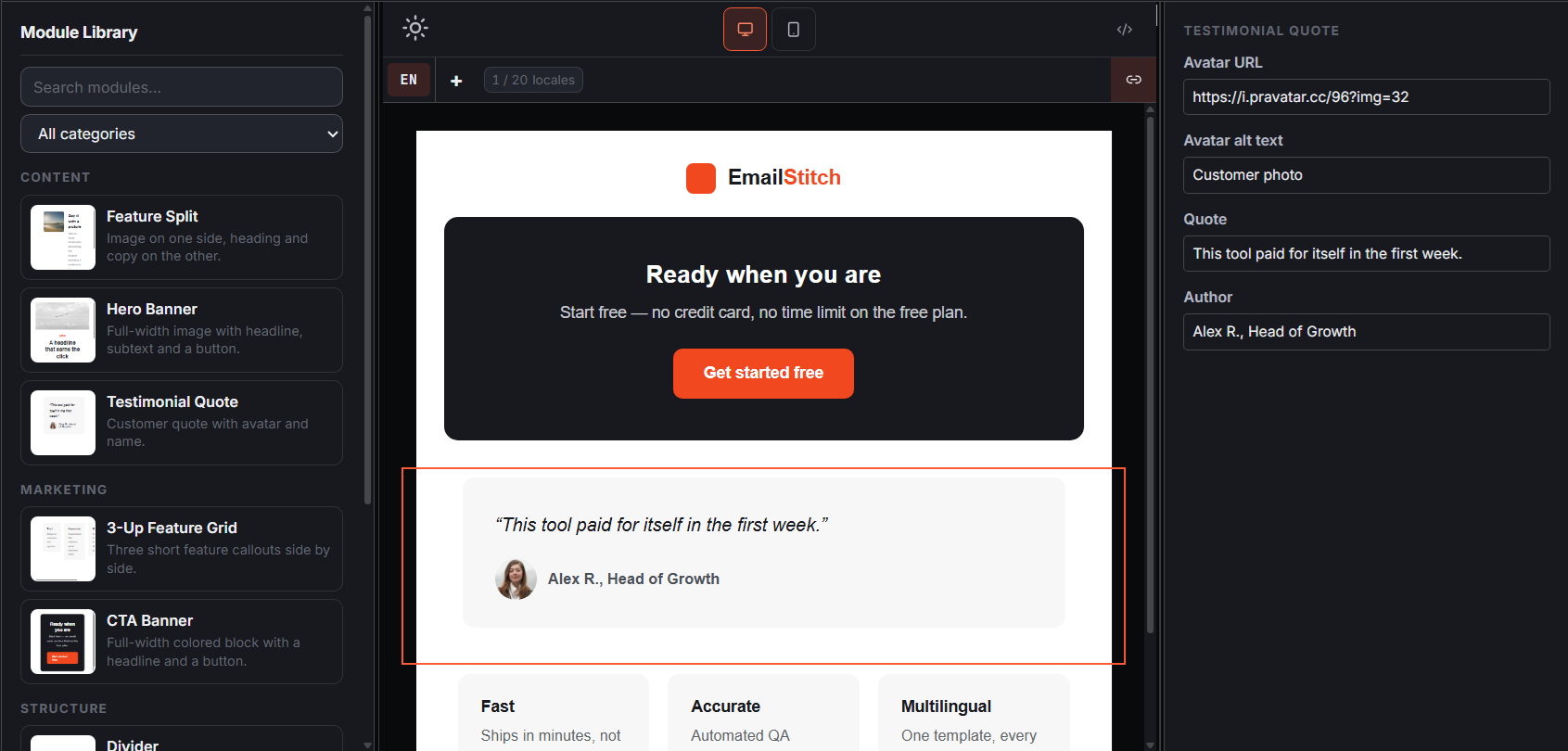
A module is a block your developers already proved: a hero, a product row, a footer with a real unsubscribe. Marketers place those blocks on the canvas. They do not rebuild the table each time, and they do not get a blank drag-and-drop kit with no relation to the file you maintain.
Modules are one stage of the HTML email production workflow. They are how build stays fast after the system exists. They are not the localization grid, and they are not QA.
Tokens instead of one-off values
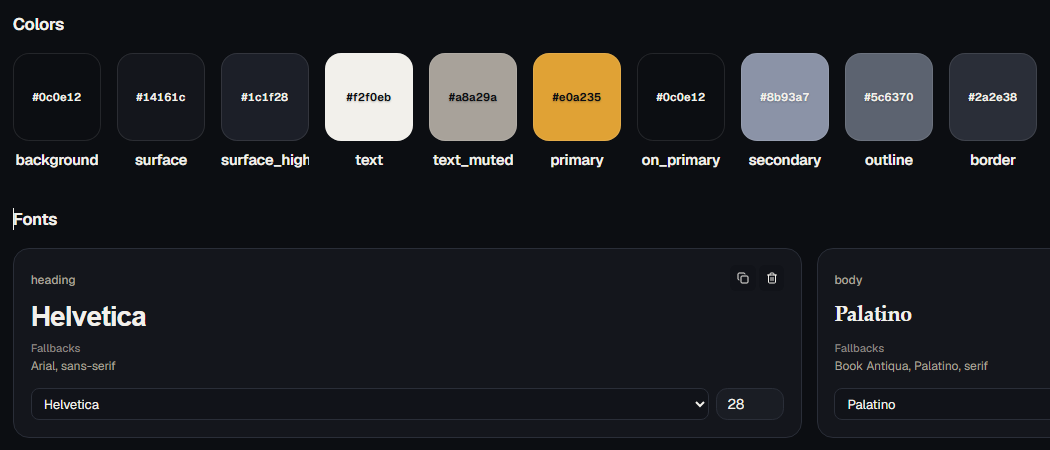
Color and type live as workspace theme tokens, referenced from the HTML as {{theme.*}}. A primary color changes once. Campaigns that use the token pick it up. Hard-coded hex values in every template are how a design system quietly stops being one.
The same idea covers type stacks: a heading font and a body font, with fallbacks, named once. The HTML keeps the reference. The token panel is where the brand is edited.
Guardrails on what non-developers can touch
Translation and field editing exposes text, images, and links. Table structure and layout are not selectable. A teammate can rewrite a headline or swap an image and cannot accidentally delete the conditional that keeps Outlook honest.
That split is the guardrail: developers own the HTML, everyone else edits fields the HTML already declared. The system does not depend on a proprietary module language to enforce it.
Related
Questions
Do marketers edit the HTML?
They edit fields: text, images, and links. The table structure stays with the people who own the HTML. It is not selectable in the field editor.
Can developers still write the template by hand?
Yes. The HTML editor and the module canvas are two ways into the same file. You are not required to assemble everything from blocks.
Is the design system locked to proprietary markup?
No. You write standard HTML. Theme tokens and translation tokens are plain placeholders. ZIP export is standard HTML with no EmailStitch runtime attached.
Start the design system from your HTML
Create an account. Shared HTML, translations, QA, and ESP push in one workspace.
Start building free